Sonus Zen Ingredients: What Is in Each Capsule, Dose by Dose
Quick Answer: What Are the Sonus Zen Ingredients?
The Sonus Zen ingredients are twelve: five vitamins (C, niacinamide, B-6, folate, B-12) and seven botanicals led by 175 mg hawthorn berry. Each has its own printed amount, with no proprietary blend. One capsule a day, 60 capsules a bottle. No trial on the finished formula is published.
Key facts
- Vitamins: vitamin C, niacin as niacinamide, B-6 as P5P, folate and B-12.
- Botanicals: hawthorn, garlic, olive leaf, hibiscus, buchu, juniper and green tea.
- Disclosure: all twelve amounts are printed, so no proprietary blend hides a dose.
- Directions: one capsule daily with an 8 oz glass of water.
- Evidence: no trial has been published on the finished formula.
If you are checking the Sonus Zen ingredients before you buy, start with the label and ignore the sales language. The sales page names no ingredients at all. The Supplement Facts panel names every one, with an amount beside it. That is rare in this category, and it is the reason a fair review is possible.
What are the Sonus Zen ingredients, and how much of each is in a capsule?
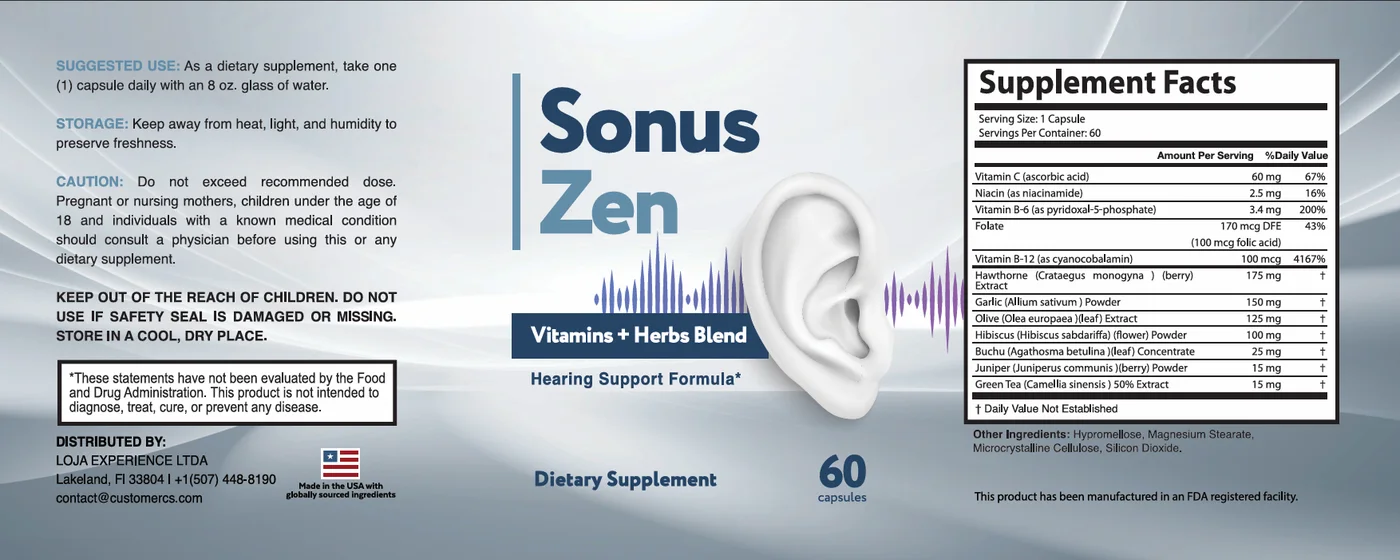
One capsule holds five vitamins and seven botanicals. The serving size is one capsule and a bottle holds 60 servings. The table below lists each line as the panel prints it.
| Ingredient | Amount per capsule | Daily Value |
|---|---|---|
| Vitamin C (ascorbic acid) | 60 mg | 67% |
| Niacin (as niacinamide) | 2.5 mg | 16% |
| Vitamin B-6 (as pyridoxal-5-phosphate) | 3.4 mg | 200% |
| Folate (from 100 mcg folic acid) | 170 mcg DFE | 43% |
| Vitamin B-12 (as cyanocobalamin) | 100 mcg | 4,167% |
| Hawthorn berry extract | 175 mg | not published |
| Garlic powder | 150 mg | not published |
| Olive leaf extract | 125 mg | not published |
| Hibiscus flower powder | 100 mg | not published |
| Buchu leaf concentrate | 25 mg | not published |
| Juniper berry powder | 15 mg | not published |
| Green tea extract (50% standardised) | 15 mg | not published |
Add the seven botanicals together and you get 605 mg. Hawthorn is the largest single line. That tells you what the formula is built around: circulation botanicals first, vitamins second.
How do the five vitamins on the panel work?
Folate, B-6 and B-12 are formulated as a set because they sit on the same pathway, the one that handles homocysteine. The B-6 is the P5P form, which is already active, so the body does not need to convert it. The niacin is niacinamide, the form that does not cause the flush that plain niacin can. Vitamin C is there as an antioxidant.
The B-12 figure looks alarming. It is 4,167% of the Daily Value. B-12 is water soluble and absorbed poorly from oral doses, so supplements routinely carry hundreds of times the Daily Value. The excess is excreted. A large percentage here is normal and is not a sign of a strong dose.
What do the seven botanicals do?
Hawthorn berry, garlic, olive leaf and hibiscus are the circulation half of the formula. All four have human research on blood pressure or vessel tone. The idea is that the inner ear is fed by a single small end artery with no backup supply, so circulation is the lever this category reaches for. It is a plausible idea. It is not a proven one.
Buchu and juniper are traditional diuretic herbs. They are present at small amounts, 25 mg and 15 mg. Human evidence for buchu is thin. Green tea is a polyphenol antioxidant at 15 mg of a 50% standardised extract. That is far below the amounts used in green tea trials, so think of it as formulation support, not an active dose.
See the full panel and today's pack options
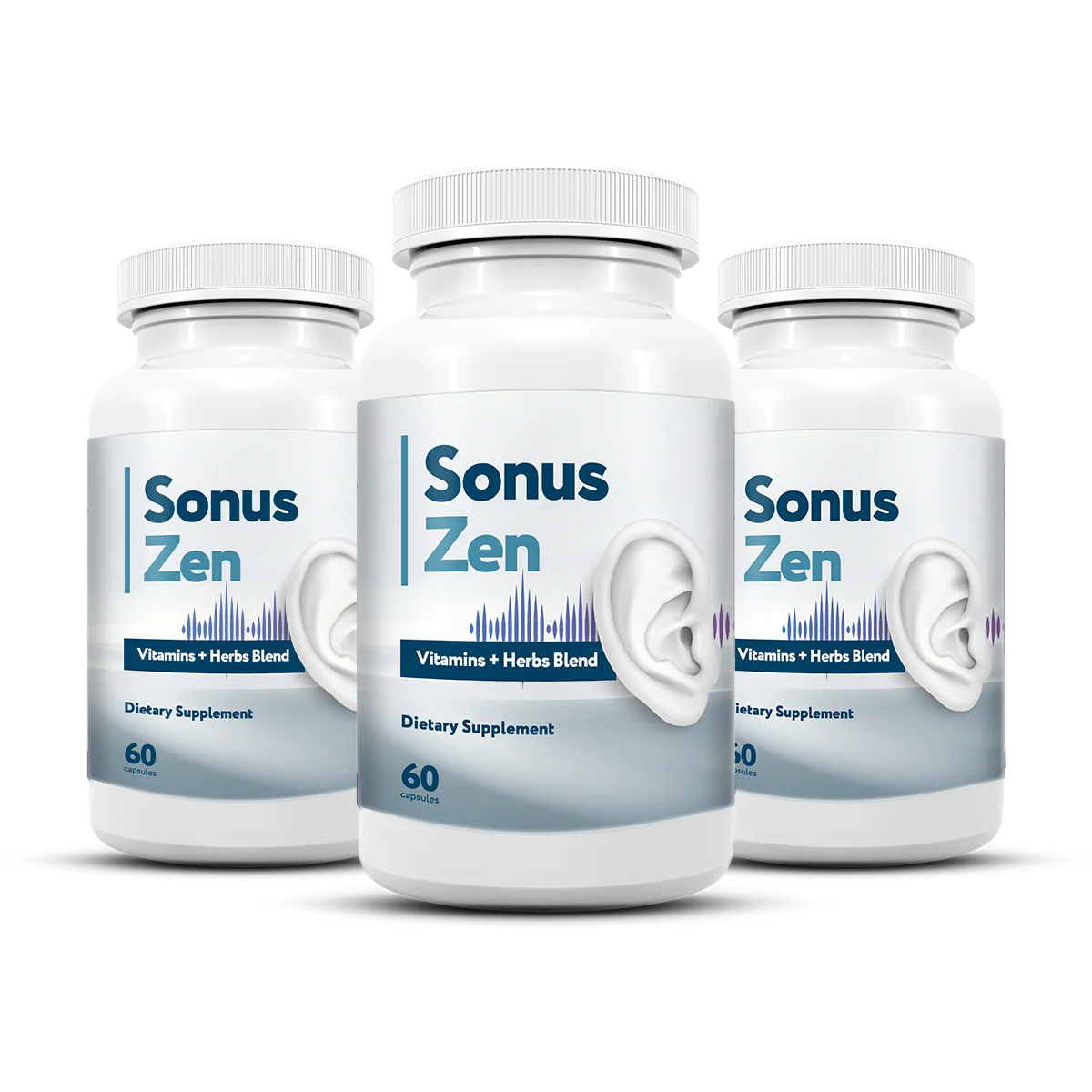
Every amount in the table above comes from the label. The official store shows today's packs, price and guarantee.
See today's price and guaranteeWe may earn a commission on purchases at no additional cost to you.
Which Sonus Zen ingredients sit below the studied dose?
Be honest about the gaps. The most cited hearing trial for any of these nutrients used folic acid. That trial gave 800 mcg a day for three years. This capsule carries 100 mcg of folic acid, which is one eighth of that. The trial also took place in a population with low dietary folate, which the United States is not.
Hibiscus is the other one to watch. It has some of the better blood pressure data of any botanical on the panel, but trials usually use it as a brewed tea at amounts well above 100 mg of powder. Green tea, as above, is a fraction of trial amounts. None of this makes the product bad. It means the label should be read as a nutrient and botanical formula, not as a copy of a trial.
What else is in the capsule besides the active lines?
The other ingredients are hypromellose, magnesium stearate, microcrystalline cellulose and silicon dioxide. These are the capsule shell and the flow agents that help the powder fill evenly. The label shows no added sugar line and no stimulant line. There is no caffeine dose to speak of.
Who should talk to a doctor first?
Anyone who takes prescription medication, is pregnant or nursing, or is under 18 should speak to a doctor before starting. The reasons are specific. Garlic has an antiplatelet effect and appears on pre-surgery stop lists. Hawthorn and hibiscus can add to blood pressure and heart medication. Buchu and juniper are diuretics, and juniper is not advised in pregnancy or with kidney disease.
Sudden hearing loss in one ear is a medical emergency. It needs assessment within days. A supplement is not a substitute for that visit.
For more context, read our guide to which vitamins actually help and the interaction checklist for garlic, hawthorn and hibiscus. You can also go back to the SonusZen home page.
Medical note: this is a dietary supplement, not a drug. These statements have not been evaluated by the FDA. Speak to a clinician before starting anything new, and seek care at once for sudden hearing loss.
Frequently asked questions
How many Sonus Zen ingredients are there?
Twelve. Five are vitamins (vitamin C, niacinamide, vitamin B-6 as P5P, folate and vitamin B-12) and seven are botanicals (hawthorn berry, garlic, olive leaf, hibiscus, buchu, juniper and green tea). Every one has its own printed amount.
Is there a proprietary blend in Sonus Zen?
No. All twelve ingredients carry their own milligram or microgram figure on the Supplement Facts panel. That makes it possible to compare each dose with the research.
What is the biggest ingredient in Sonus Zen?
Hawthorn berry extract at 175 mg per capsule is the largest single line. Garlic powder follows at 150 mg and olive leaf extract at 125 mg.
Why is the B-12 percentage so high on the label?
The capsule has 100 mcg of vitamin B-12 as cyanocobalamin, shown as 4,167% of the Daily Value. B-12 is water soluble and absorbed poorly by mouth, so supplements often run far above the Daily Value. The excess is excreted.
Does the folate dose match the hearing trial?
No. The well-known folic acid trial used 800 mcg daily for three years. The capsule has 100 mcg of folic acid, shown as 170 mcg DFE of folate.
How do you take it?
The label says one capsule daily with an 8 oz glass of water, stored in a cool, dry place away from heat, light and humidity. Give it eight to twelve weeks before you judge it.
Our view
The panel is honest and complete, and that is the best thing about it. You can check every dose. What you cannot do is point to a trial on the finished capsule, because none is published, and the folate amount is well below the trial people quote. If you like a fully disclosed formula built on circulation botanicals and B vitamins, it is a reasonable one to consider, with a doctor's input if you take medication. If you want proof of a hearing result, the panel cannot give you that.
Related reading
Check the official SonusZen offer
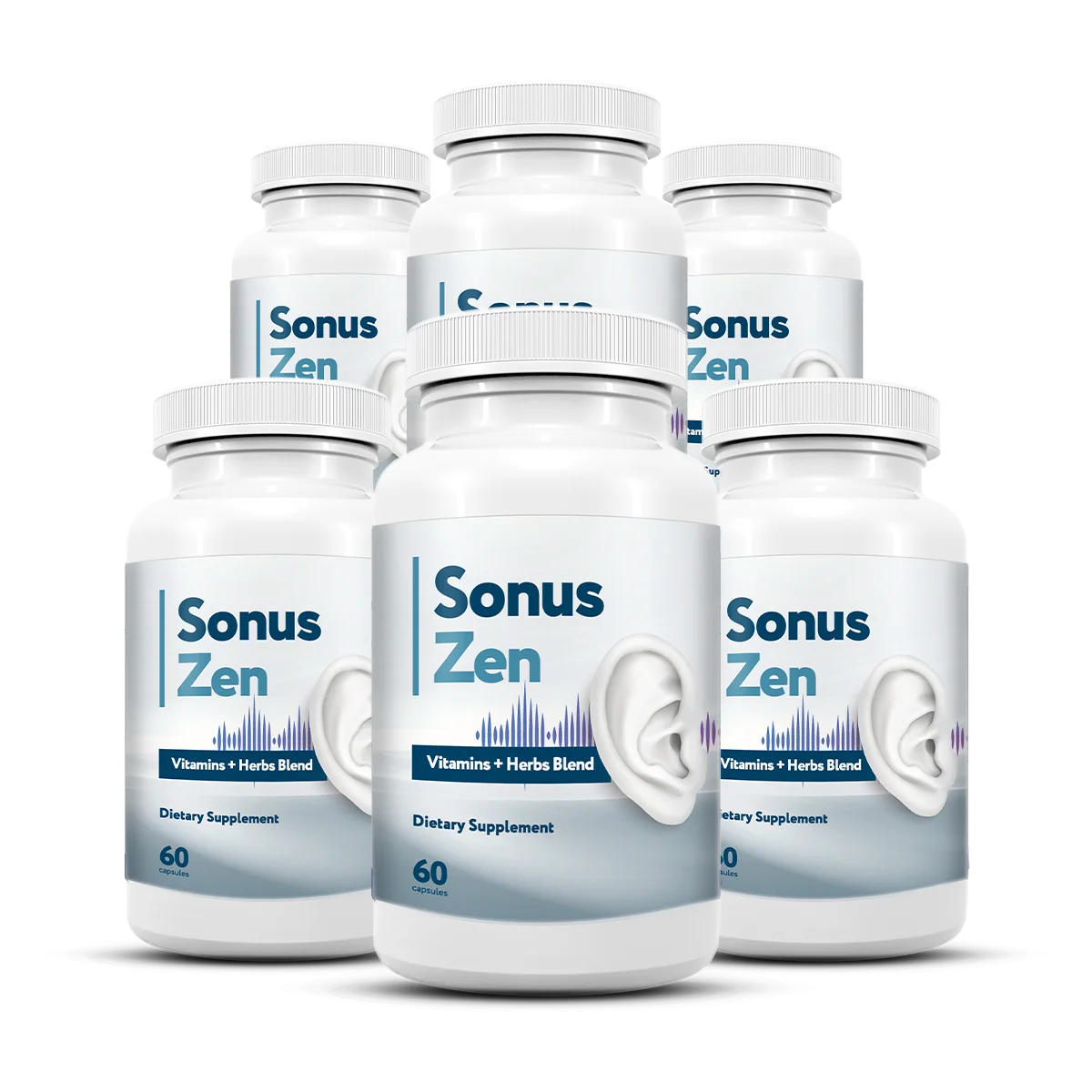
Read the panel, compare the packs, and confirm the price and the 60-day guarantee on the official checkout before you order.
See today's price and guaranteeWe may earn a commission on purchases at no additional cost to you.